

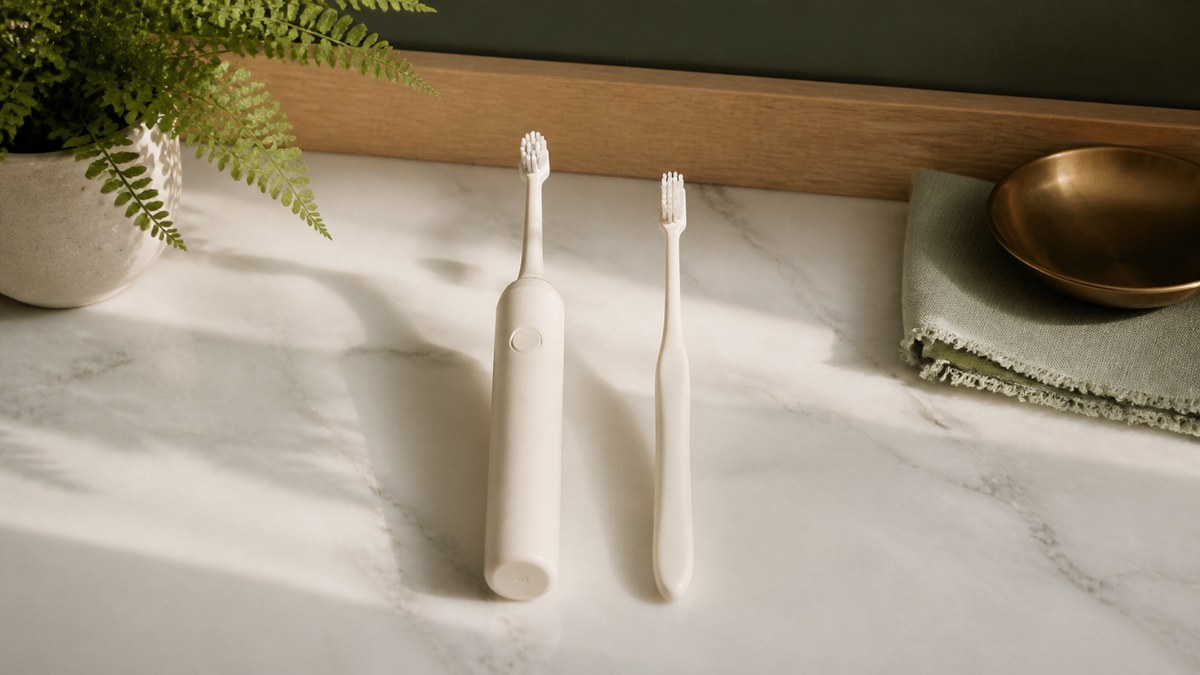
If you want the short answer: an electric toothbrush has a small, measurable advantage over a manual one, and how you brush matters more than which brush you hold. Both statements are true at the same time, and most of the electric vs manual toothbrush debate goes wrong by insisting on only one of them.
Patients at our Oakland, FL studio ask about this constantly, usually while holding a box they’re not sure they should have opened. The useful version of the answer depends less on the hardware than on your hands, your habits, and what your gums currently look like, so here it is question by question, the way it usually comes up in the chair with patients around Winter Garden and 34787.
Does an Electric Toothbrush Really Clean Better?
Slightly, and the finding has held up. Systematic reviews pooling many randomized trials have found that powered brushes remove somewhat more plaque and reduce gum inflammation somewhat more than manual brushes across studies running one to three months.
Two caveats keep that in perspective. The advantage is modest rather than transformative, and study conditions involve participants who know they’re being observed, which tends to improve everyone’s technique. In ordinary daily use, the gap between a well-used manual brush and a poorly used electric one runs the other direction.
So the accurate framing isn’t that electric brushes clean better. It’s that they make it easier for the average person to clean adequately, which over years is worth something.
Which Electric Brush Type Has the Better Evidence?
There are two main categories. Oscillating-rotating brushes use a small round head that rotates back and forth, sometimes with a pulsing motion. Sonic brushes use a larger, more conventional head vibrating side to side at high frequency.
Oscillating-rotating designs have the longest track record in clinical research and the largest volume of it. Sonic brushes also perform well in trials. If you want the option with the deepest evidence base, the round-head design is the safer pick. If you find the sonic feel more comfortable and will actually use it, that consideration outweighs the difference between them.
What doesn’t hold up is the marketing around ultrasonic claims, whitening heads, and app-connected coaching. Those features sell brushes. They don’t move the clinical needle much.
Why Technique Beats Hardware
Plaque is soft. It comes off with light contact and thorough coverage, not force. What most people miss isn’t power, it’s the places their brush never visits: the inner surfaces of the lower front teeth, the outer surfaces of the upper molars, and the gum line itself, where periodontal disease starts.
The fundamentals are the same regardless of tool:
- Angle the bristles toward the gum line, roughly forty-five degrees, rather than straight at the tooth.
- Work systematically through outer, inner, and chewing surfaces so nothing gets skipped.
- Let an electric brush do the work. Guide it slowly along each tooth instead of scrubbing with it, which is the most common mistake in the first week of ownership.
- Give it the full two minutes. People routinely brush for well under that and estimate they brushed longer.
This is also where the ecology of the mouth comes in. Regular disruption of biofilm is what keeps the bacterial balance from shifting, a mechanism our piece on the oral microbiome works through in more detail. The brush is a means of disruption. Any brush that reaches everywhere achieves it.
What a Pressure Sensor Is Actually Preventing
This is the feature we’d argue for most, and it gets the least attention in advertising.
Brushing too hard doesn’t remove more plaque. It wears away enamel and cementum at the gum line and contributes to gum recession, and the exposed root surface that results is both more prone to decay and often uncomfortable. That discomfort is one of the more common complaints we hear, and our look at why teeth become sensitive covers how the exposure develops.
Heavy-handed brushers are usually surprised to learn they’re heavy-handed. A pressure sensor that lights up or cuts power gives immediate feedback that no amount of advice from a hygienist reliably provides. If you’ve been told you brush too hard, or your bristles splay within weeks of opening the package, that single feature justifies the purchase.
The Timer Is the Underrated Feature
Most people believe they brush for two minutes. Most people brush for closer to one. A built-in timer with thirty-second quadrant prompts closes that gap without requiring any willpower, and the extra time is where the real-world benefit of electric brushes probably comes from.
You can get the same result with a phone timer and a manual brush. Almost nobody does.
Who Gets the Most Out of Switching
Some people should stop debating and just switch:
- Anyone with limited dexterity. Arthritis, tremor, stroke recovery, or any condition affecting grip and wrist motion. The brush supplies the motion your hand no longer can.
- Braces wearers. Brackets and wires trap plaque in places manual brushing reaches slowly and imperfectly.
- Aligner patients. Trays sit against the teeth most of the day, so anything left on the enamel stays there. Speed and thoroughness before reinserting matter more here than usual.
- Heavy-handed brushers, for the pressure sensor alone.
- People with existing recession or gum disease, where careful gum-line technique matters most and inflammation carries consequences beyond the mouth, as our discussion of gum disease and heart disease considers.
- Implant patients. Peri-implant tissue needs meticulous daily care, and the routine described in caring for dental implants long term is easier to sustain with a powered brush and a soft head.
- Anyone with a history of frequent cavities, where every marginal improvement in plaque control helps slow the process outlined in the stages of tooth decay.
Everyone else can reasonably use either.
Bristles: Soft, Every Time
This choice matters more than the electric question and costs nothing.
Use soft bristles. Medium and hard brushes don’t clean better, and combined with pressure they accelerate wear at the gum line. There’s no adult case we make for a hard-bristled brush. Head size matters too: a smaller head reaches behind the last molars and around crowded teeth where a large one simply cannot.
Replacement Heads and the Real Cost
Bristles wear out. Replace heads about every three months, sooner if they look bent or splayed, and after an illness involving the mouth or throat. A worn head cleans measurably worse, and this applies to manual brushes just as much, though people keep those far longer than they should.
The honest cost comparison: a manual brush costs a few dollars and needs replacing quarterly. An electric brush is a larger upfront purchase plus ongoing head replacements that typically cost several times what a manual brush does. Over a decade that adds up.
Whether it’s worth it depends on you. If the head cost would tempt you to stretch replacements to six months, the manual brush is the better buy. If the timer and pressure sensor change your habits, the spending is doing something. Buying an expensive brush and using it for forty seconds is the one outcome that helps nobody.
What No Toothbrush Can Do
Here’s the part that matters more than everything above.
No toothbrush of any kind cleans between your teeth. Bristles don’t reach the surfaces where teeth touch, and those contact areas are where most cavities between teeth begin and where periodontal disease typically starts. Floss, interdental brushes, or a combination handles that, and interdental brushes are often easier and more effective for people with larger gaps.
Fluoride is the other half no brush provides on its own, which is why the paste on the bristles matters, and why we walk through the evidence in our piece on the truth about fluoride.
The tool is not the plan. Twice-daily brushing with any decent brush, daily cleaning between the teeth, fluoride, and regular professional cleanings constitute the plan. The brush is one component of it, and the least important one to agonize over.
Ready to Find Out Whether Your Technique Is Working
The fastest way to settle the electric versus manual question for yourself is to have someone look at where plaque is actually accumulating in your mouth and tell you which surfaces you’re missing. Reach out to schedule a cleaning and exam, or join our VIP list to stay connected with our Oakland, FL studio.