

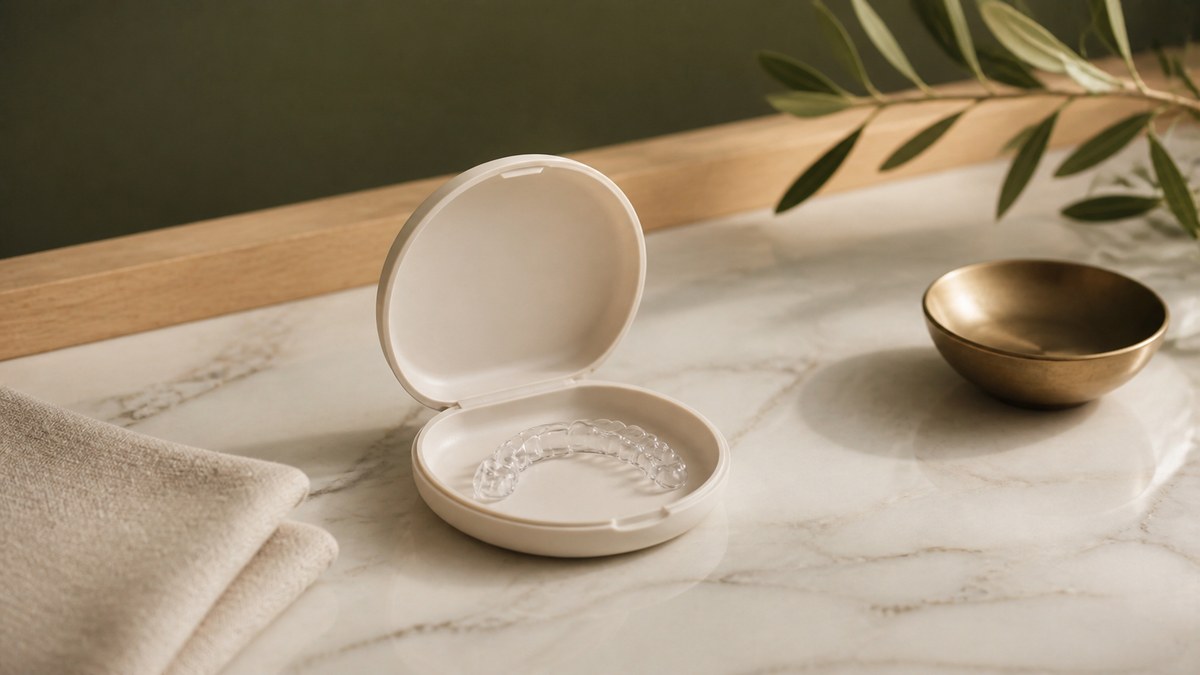
Retainers after Invisalign are not the last step of treatment. They’re the part that never stops. Teeth are held in bone by living tissue that remembers where they used to be, and that memory doesn’t expire on a schedule.
This is the piece of orthodontic care that gets undersold most often, usually because nobody wants to end an exciting conversation about a new smile with a lifelong homework assignment. We’d rather say it early. If you finish aligner treatment and stop wearing anything, your teeth will move. Not always dramatically, and not always quickly, but reliably.
Here’s why relapse happens, what the retainer options actually are, and what a realistic long-term routine looks like at our Oakland, FL studio serving Winter Garden, Clermont, and the surrounding areas.
Why Teeth Drift Back
Two separate forces work against a finished result, and they operate on different timelines.
Periodontal fibers pull. Each tooth is suspended in its socket by a network of collagen fibers, and a band of them runs over the top of the bone from tooth to tooth. When a tooth rotates or translates into a new position, those fibers stretch. They remodel slowly, over many months, and until they do they exert a quiet, constant pull back toward the original position. Rotated teeth are the classic offenders here, because rotational relapse is fast and visible.
Faces keep changing. The second force has nothing to do with treatment at all. Teeth drift forward and crowd through adult life whether or not anyone ever moved them. Lower front crowding in your thirties and forties is so common it’s almost expected. Chewing forces, soft tissue pressure from lips and tongue, enamel wear at the contact points, and gradual changes in the jaws all contribute. That process doesn’t pause because you completed aligner therapy.
The first force is the reason the initial months of retention are intensive. The second is the reason retention never fully ends.
The Two Kinds of Retainer
Fixed or bonded retainers
A fixed retainer is a thin wire bonded to the tongue side of the front teeth, most often the lower six. It’s invisible from the front, it works twenty four hours a day, and it removes compliance from the equation entirely.
The trade-off is hygiene. Floss won’t pass between bonded teeth in the normal way, so you need a threader or a water flosser and the willingness to use them. Tartar builds along a neglected bonded wire, and the gum inflammation that follows is a real problem rather than a theoretical one. Bonds also fail occasionally on a single tooth, which lets that tooth move while its neighbors stay anchored. That’s why a bonded retainer still needs a periodic look from a dentist, and why we check them at routine visits along with everything else covered in a general and preventive exam.
Removable clear retainers
Vivera-style clear retainers look much like the aligners you just finished with, but they’re made from thicker, more durable material meant for years of nightly use rather than two weeks of active movement. They cover the whole arch, they hold rotations well, and most people find them easy to accept because the sensation is already familiar.
They also depend completely on you. A retainer in a drawer holds nothing. The failure mode is not dramatic breakage but slow attrition: a few skipped nights, then a week, then it doesn’t fit quite right, then it’s in a drawer for good.
Traditional wire and acrylic retainers, the ones most adults remember from childhood, are still perfectly good appliances. They’re more durable than clear plastic and easier to adjust, but they’re more visible and some people find them bulkier to sleep in.
Many patients end up with a combination: a bonded wire on the lower front teeth and a removable clear retainer on top, sometimes on both arches. That belt and suspenders approach is common for a reason.
What a Realistic Wear Schedule Looks Like
Schedules vary by case, and someone who closed a large space or corrected a significant rotation needs more retention than someone who fixed mild crowding. As a general shape:
- The first few months: full time. Essentially the same wear you were doing during active treatment, out for eating, drinking anything but water, and cleaning. This is when the periodontal fibers are doing most of their remodeling and when relapse risk is highest.
- Months four through twelve: tapering. Full time drops to evenings plus overnight, then to nights only, based on how the teeth are holding.
- Year two onward: nights, indefinitely. For most people this becomes as automatic as a nightguard.
Some patients eventually move to a few nights a week after years of stability. That’s a reasonable conversation to have with your dentist, and it has a built-in test: if the retainer still seats easily, the schedule is working. If it feels tight, you’ve cut back too far. Going back up a night or two is easier than starting over. If you found the daily discipline hard during active treatment, our discussion of what happens when you skip aligner wear applies just as much to the retention phase.
When a Retainer Feels Tight After a Gap
This is one of the most common retainer questions, and the answer depends on whether it seats.
Put it in gently. If it goes all the way down with some pressure and a bit of soreness, your teeth moved a little and will settle back over a few consistent nights. Expect some tenderness for a day or two, the same mild ache you felt when changing aligner trays.
If it doesn’t seat, stop. Forcing a retainer that no longer fits can crack the plastic, or worse, apply force in a direction nobody planned and move a tooth somewhere unhelpful. That’s the point to have it looked at. Depending on how far things drifted, the fix may be a new retainer or a short course of limited retreatment, which is far less involved than a full case.
Lifespan, Replacement, and Spares
Clear retainers are consumables. With nightly wear, one to three years is a fair expectation, and people who clench or grind burn through them faster. The signs it’s time are cracking, clouding, distortion, a fit that has gone loose, or a tray that no longer seats fully.
Ordering a spare set at the same time as the first is one of the better small decisions in this whole process. Retainers get lost in restaurant napkins, hotel rooms, and airport security bins with remarkable consistency, and a spare in the bathroom drawer means a lost retainer costs you a phone call instead of weeks of unretained teeth. With iTero scanning, we keep a digital record of your finished position, which also makes reordering simpler than taking new impressions from scratch.
Cleaning Without Ruining the Plastic
Retainers spend eight hours a night pressed against your teeth, so the cleaning rules that applied to your aligners carry over unchanged. Rinse it as soon as it comes out, before saliva dries into a film. Brush it gently with a soft brush and a drop of mild, uncolored soap. Skip toothpaste, which is abrasive enough to scratch the plastic, and skip hot water entirely, because heat warps a retainer permanently and there’s no fixing it afterward. Let it dry before it goes in the case, and keep the case somewhere consistent.
A Personal Ultrasonic Bath
Brushing handles the smooth outer surfaces well, but a clear retainer is full of small contours that trace every groove of your teeth, and a soft brush doesn’t reach all of them. A personal ultrasonic cleaner is a small countertop bath that sends high-frequency vibrations through water, creating tiny bubbles that lift film and debris out of those contours without any scrubbing. Because nothing abrasive touches the plastic, it’s one of the gentlest ways to get a retainer truly clean.
A few habits keep it working for the retainer rather than against it:
- Use cool or lukewarm water. Some units include a heat setting. Leave it off, because warm water in a closed bath can warp plastic just like a hot tap.
- Add a retainer cleaning tablet or a drop of mild soap. The vibration does the mechanical work, and the cleaner helps with film and odor. Skip bleach and alcohol-based mouthwash, which can cloud or weaken the plastic over time.
- Keep cycles short. A few minutes is plenty. Running cycle after cycle doesn’t make it cleaner.
- Rinse afterward and clean the bath. Rinse the retainer before wearing it, then empty the tank and let it air dry so the bath itself doesn’t grow bacteria.
An ultrasonic bath is a supplement, not a replacement. Rinsing and a gentle brush still belong in the daily routine, with the ultrasonic cycle a few times a week or whenever the retainer starts to look cloudy. The same bath works for a nightguard, or for aligners if you’re still in treatment. It doesn’t help a bonded wire retainer, which stays on the teeth and gets cleaned with floss threaders or a water flosser instead.
What Losing Retention Actually Costs
The blunt version: relapse means paying twice. A second course of aligners, even a limited one, costs real money and real months, and it’s entirely avoidable with a piece of plastic you wear while asleep.
There’s a quieter cost too. Crowded lower front teeth are harder to clean, and areas that are hard to clean develop gum inflammation and decay. Shifting can also change how your teeth meet, which loads some teeth more heavily than others and shows up years later as wear or recession. If crowding returns and the gum line becomes uneven as a result, the conversation can drift toward gum reshaping or other cosmetic corrections that wouldn’t have been needed at all.
Retention is the cheapest part of orthodontics and the part that determines whether the rest of it was worth doing. If you’re weighing treatment now, factor lifelong retainers into the decision the same way you’d factor the treatment timeline, the range of problems clear aligners can correct, or the reasons adults choose clear aligners in the first place.
Ready to Talk About Keeping Your Results
Whether you’re finishing aligner treatment, wondering if your old retainer still fits, or watching your lower front teeth crowd again years after braces, the useful first step is having someone actually look. Join our VIP list and we’ll reach out when our books open in Oakland, FL.