

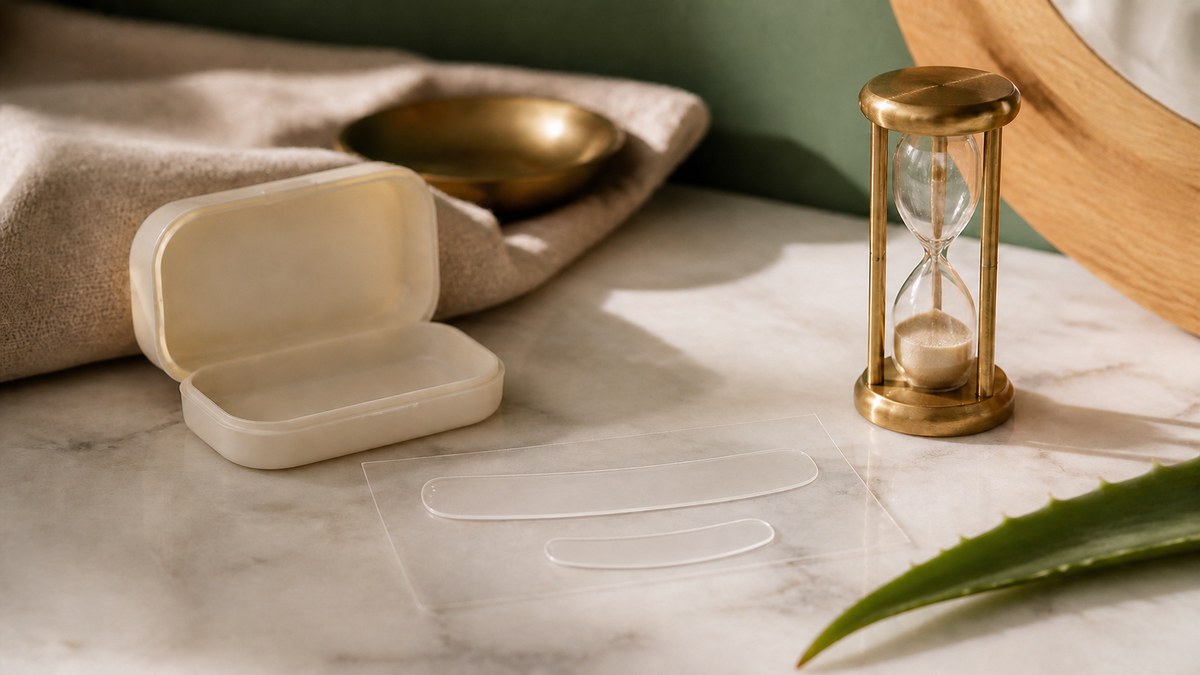
For most healthy adults, whitening strips are safe. Peroxide-based strips carrying the ADA Seal of Acceptance have been studied for decades, and used at labeled concentrations for labeled durations they don’t measurably damage enamel. The realistic downsides are temporary tooth sensitivity and gum irritation, both of which resolve when you stop.
The more useful version of the question “are whitening strips safe” is: safe for whom, and used how. Strips become a problem when they’re used over untreated decay or gum disease, when someone runs course after course chasing a result the material can’t deliver, or when the product comes from an unregulated source with no disclosed peroxide concentration. We see all three at our Oakland, FL studio, and the first is the one that causes real pain.
Here’s what the risks are, who should hold off, and where strips fit against the alternatives.
How Whitening Strips Work
A whitening strip is a flexible film coated with a peroxide gel, usually hydrogen peroxide or carbamide peroxide at a lower concentration than professional products. Pressed against the teeth, the peroxide passes through enamel into dentin and breaks apart the large pigment molecules that make teeth look dark.
That last point is worth holding onto, because it corrects a common misunderstanding. Whitening isn’t scrubbing stain off the surface. It’s a chemical reaction happening inside the tooth. That’s why peroxide can lighten a tooth without abrading it, and why abrasive products that only polish the surface produce a much smaller change.
Are Whitening Strips Safe for Enamel?
Peroxide at the concentrations used in consumer strips doesn’t soften or dissolve enamel in any way that shows up clinically. Laboratory studies that report surface changes typically use exposures far beyond what any package instructs.
What can damage enamel isn’t the peroxide:
- Acidic formulations. Some cheap or imported products have a low pH that erodes enamel independent of any whitening effect.
- Abrasion. Charcoal and heavy-grit whitening pastes scrub the surface. Over years, that wears enamel and dulls the polish on any restorations.
- Gross overuse. Running strips continuously for months is outside what has been studied and outside what the product is designed for.
Stick to a mainstream peroxide product with a stated concentration, follow the package, and enamel isn’t the concern.
Sensitivity Is the Real Side Effect
Roughly half of people who whiten experience some sensitivity, and strips are no exception. Peroxide reaching dentin briefly increases fluid movement in the microscopic tubules that lead toward the nerve, producing the sharp, short zings people describe with cold air or water.
It’s temporary. It resolves within a few days of stopping and leaves no lasting damage. To reduce it:
- Use a potassium nitrate sensitivity toothpaste for a week before starting and throughout.
- Shorten the wear time rather than skipping days entirely.
- Whiten every other day instead of daily.
- Avoid very hot and very cold foods while you’re mid-course.
One distinction matters. General sensitivity across several teeth is expected. Sharp, localized pain in one specific tooth isn’t, and it usually means peroxide has reached the interior through a crack, a cavity, or an exposed root. That warrants an exam rather than a shorter wear time. Our explanation of why teeth become sensitive covers how to tell those two patterns apart.
Gum Irritation and Poor Fit
Strips are one size, and teeth aren’t. When a strip overlaps the gums, peroxide sits against soft tissue and produces white patches, tenderness, and occasionally a chemical burn.
The tissue recovers within a few days, but the fit problem is also why strips underperform on crowded or rotated teeth. Gel that can’t reach a rotated surface won’t whiten it, which is how people end up with an uneven result. Custom trays exist precisely to solve this, and they’re the main practical advantage of professional whitening over an over-the-counter kit. Our comparison of teeth whitening options lays out where each method fits.
Who Should Not Use Whitening Strips
This is the part of the answer that actually matters, because it’s where the harm happens.
Hold off, and get an exam first, if you have:
- Untreated decay. Peroxide entering a tooth through a cavity reaches the nerve directly. This is painful and entirely avoidable.
- A cracked tooth or a leaking restoration. Same mechanism, same result.
- Active gum disease or significant recession. Exposed root surface has no enamel covering it, so it’s both more sensitive and unresponsive to whitening.
- Front-tooth crowns, veneers, or bonding. They won’t change color and can end up looking darker than everything around them.
- Pregnancy or nursing. Whitening is elective, and the usual advice is to wait.
Children and teens should whiten only under a dentist’s direction, since young teeth have larger nerve chambers and more sensitivity.
Not All Whitening Products Are the Same
The safety record of peroxide strips doesn’t transfer to everything sold as a whitening product, and this is where most of the real risk sits.
- Unregulated online kits. Products bought from marketplaces with no disclosed peroxide concentration are the ones behind most reports of burns and severe sensitivity. Some have been found to contain concentrations several times what any consumer product should carry.
- Charcoal pastes and powders. These are abrasives rather than whiteners, and the grit in many of them is coarse enough to wear enamel at the gum line where it’s already thinnest.
- Non-dental salon and kiosk whitening. In many settings the operator isn’t licensed to diagnose, so nobody checks for the decay, cracks, or gum disease that make whitening a bad idea in the first place.
- Acidic gimmick remedies. Lemon juice and vinegar strip mineral out of enamel. Baking soda used aggressively abrades it. Neither belongs in a whitening routine.
A mainstream strip with a stated peroxide concentration and an ADA Seal is a well-studied product. The category around it is not uniformly so. The same split shows up in orthodontics, where doctor-supervised aligners and mail-order brands aren’t the same purchase.
Strips Versus the Alternatives
Strips are the weakest of the peroxide options and the most convenient. They typically lighten a few shades over one to two weeks, which is a real result on mild surface staining and well-aligned teeth.
They won’t help much with deep intrinsic discoloration from trauma, certain medications, or naturally darker dentin, and what caused the yellowing in the first place predicts the outcome better than the brand does. Whitening a tooth that’s dark for structural rather than surface reasons is disappointing regardless of the product, and that outcome is worth predicting before you spend two weeks trying. When color isn’t the only thing you want to change, treatments like veneers or bonding address shape and color together.
Ready to Whiten Without Guessing
If you’re not sure whether strips are the right call, or you’ve tried them and got an uneven or painful result, a short exam answers it quickly. Reach out to schedule a visit and we’ll tell you what’s actually causing your tooth color, or join our VIP list to stay connected with the studio.